Is Tapentadol 100mg Strong Enough for Severe Pain? What Australians Should Know
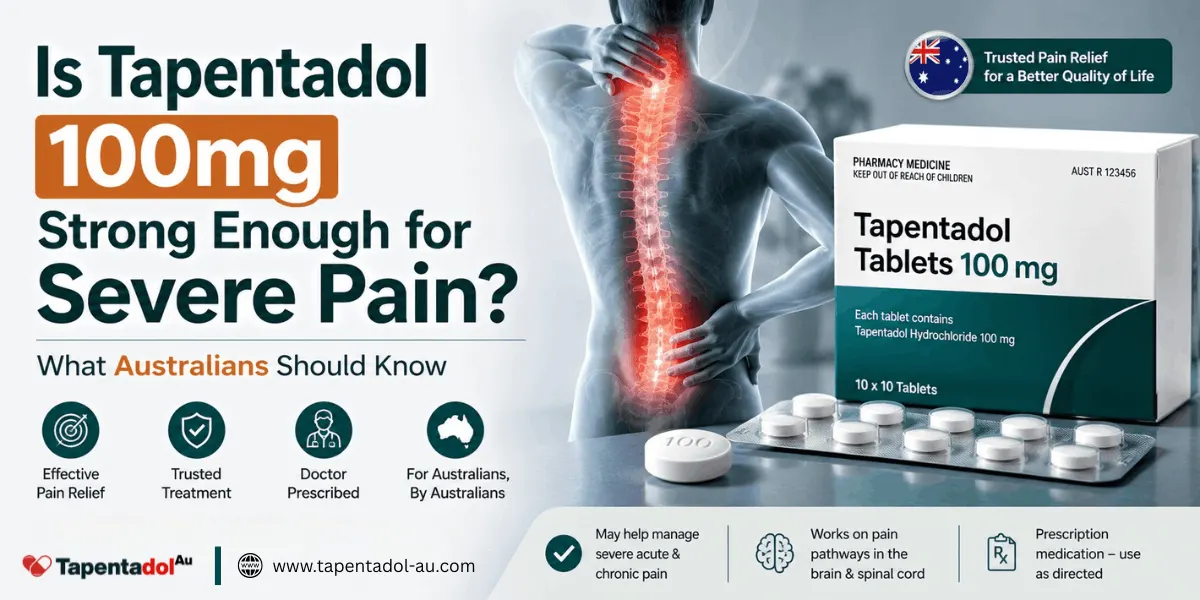
If you or someone you care for has been prescribed tapentadol, one question comes up almost immediately: is 100mg actually strong enough to handle severe pain?
It's a fair question, and the honest answer is that "strong enough" depends far less on the number on the tablet than most people expect. Below is a plain-English, Australian-focused explanation of what tapentadol 100mg does, how it compares with other opioids, and what to do if your pain isn't well controlled.
- This article is general health information only. It is not medical advice and not a recommendation to use any medicine. Tapentadol decisions belong to you and your prescriber.
What tapentadol actually is
Tapentadol is a prescription opioid analgesic. In Australia it's best known under the brand name Palexia, supplied as immediate-release (IR) tablets and sustained-release (SR) tablets.
What makes it a little unusual is that it works through two mechanisms at once:
1. Mu-opioid receptor agonism — the classic opioid pathway that dampens pain signalling in the brain and spinal cord.
2. Noradrenaline reuptake inhibition — a separate pathway that appears to help most with nerve-related (neuropathic) pain.
That dual action is why tapentadol is sometimes considered for pain with a burning, shooting or electric quality, such as diabetic nerve pain or post-surgical nerve irritation, where a single-mechanism opioid may underperform.
The critical detail: 100mg IR and 100mg SR are not the same thing
This trips people up constantly.
- Immediate-release 100mg is designed for short-acting relief. It works within roughly half an hour and lasts about four to six hours.
- Sustained-release 100mg releases the same amount of drug slowly across roughly 12 hours, giving a lower, flatter blood level intended for around-the-clock background pain.
So a person taking SR 100mg twice daily and a person taking IR 100mg occasionally are having completely different experiences of the same "100mg." SR tablets must never be crushed, split or chewed — that destroys the release mechanism and delivers the full dose at once, which is dangerous.
So how "strong" is 100mg?
In relative terms, tapentadol sits in the moderate-to-strong band. Clinicians typically estimate it at roughly 40% of oral morphine on a milligram-for-milligram basis, meaning 100mg of tapentadol is broadly in the vicinity of 40mg of oral morphine. It is generally regarded as meaningfully stronger than tramadol and somewhat less potent per milligram than oxycodone.
Two important caveats:
- These conversions are approximate and are clinical tools, not consumer tools. Australian pain specialists use calculators such as the Faculty of Pain Medicine (ANZCA) opioid calculator precisely because rough mental maths in this area causes overdoses.
- Potency is not the same as effectiveness. A drug can be "strong" and still not suit your particular pain.
For many people with severe pain, tapentadol 100mg SR twice daily provides genuine relief. For others it doesn't — and that is a clinical signal, not a personal failing.
Why the tablet strength isn't the real question
Whether any opioid dose is "enough" depends on variables that have nothing to do with the number printed on the box:
The type of pain. Opioids work reasonably well for acute tissue-damage pain. They perform far less impressively for chronic non-cancer pain, fibromyalgia, and most chronic low back pain — conditions where Australian guidelines increasingly favour movement, physiotherapy, psychological therapy and non-opioid medicines as the backbone of treatment.
Your metabolism. Tapentadol is cleared largely through glucuronidation, with some cytochrome P450 involvement. Liver and kidney function, age and genetics all shift how much active drug reaches your system.
Opioid tolerance. Someone who has taken opioids for months may need more drug for the same effect. Someone opioid-naïve may find 100mg substantial.
What else is on board. Paracetamol, NSAIDs, nerve-pain agents such as pregabalin or amitriptyline, and non-drug approaches all change the picture. Opioids usually work best as one part of a plan, not the whole plan.
The Australian regulatory picture
Tapentadol is a Schedule 8 (Controlled Drug) in the Poisons Standard. Practically, that means:
- Real-time prescription monitoring applies. Systems including SafeScript in Victoria and NSW, QScript in Queensland, ScriptCheckSA and DORA elsewhere let prescribers and pharmacists see your controlled-medicine history at the point of care.
- State authorities may be required for extended prescribing, with rules varying by state and territory.
- PBS subsidy exists for sustained-release tapentadol under restricted criteria for chronic severe disabling pain not responding to non-opioid analgesics. Immediate-release forms are more often private scripts.
- TGA opioid reforms introduced smaller pack sizes, tightened indications and added boxed warnings, alongside an expectation that ongoing opioid therapy is reviewed regularly rather than repeated indefinitely.
None of this is bureaucracy for its own sake. It exists because opioid harm in Australia has been substantial, and most of it involves prescribed medicines rather than illicit ones.
Risks worth taking seriously
Common effects include nausea, constipation, dizziness, drowsiness and dry mouth. Tapentadol is often reported as gentler on the gut than some alternatives, but "gentler" is not "harmless."
More serious concerns:
- Respiratory depression, particularly when combined with alcohol, benzodiazepines, sleeping tablets or other sedatives.
- Serotonin syndrome risk, especially alongside antidepressants such as SSRIs and SNRIs. MAOIs are contraindicated.
- Seizure risk in people with epilepsy or a seizure history.
- Dependence and tolerance, which can develop even with entirely correct use.
- Impaired driving. Driving while impaired is an offence across Australia regardless of whether a medicine was legally prescribed.
Naloxone temporarily reverses opioid overdose and is available free and without a prescription through Australia's Take Home Naloxone program. Anyone on regular opioid therapy — and the people they live with — should consider having it at home and knowing how to use it.
If 100mg isn't controlling your pain
The single most important thing: do not increase your own dose, add another opioid, or obtain medicine from anyone other than your pharmacist. Dose escalation without supervision is where most serious opioid harm begins.
Instead, book a review and bring specifics: when the pain breaks through, what it feels like, what you've tried, and how it's affecting sleep, work and mood. Options your GP may consider include adjusting the formulation or timing, adding non-opioid or nerve-pain agents, referral to a multidisciplinary pain clinic, or investigating whether something underlying has changed.
Persistent uncontrolled pain on an appropriate opioid dose is often a sign that the diagnosis or the strategy needs revisiting — not simply that the number needs to go up.
Frequently Asked Questions
Per milligram, generally yes. It's usually considered several times more potent, with a different side-effect and interaction profile.
No. Australian product information specifies daily maximums well above 100mg, but the appropriate dose for any individual is set by their prescriber, not by the ceiling in the product information.
Only under ongoing medical supervision, with regular review of whether it's still delivering meaningful benefit.
No. Abrupt cessation after regular use can cause withdrawal. Any reduction should be planned with your doctor.
Please log in to add a comment.

Dr. James Lawson, a distinguished expert in pain management and pharmaceutical sciences. With over 20 years of medical experience, Dr. Lawson remains deeply committed to advancing safe and effective pain relief solutions. Though no longer in active clinical practice, his passion for healthcare and dedication to patient education continue to thrive. Through his extensive research and medical writing, Dr. Lawson supports our pharmacy’s mission by providing trusted insights on pain management, helping our valued customers make informed health decisions.
.svg)
Delivered in secure, plain packaging on fully tracked delivery from just $20AUD.

Our team of doctors and pharmacists, and our support staff, are all AUS-based.
.svg)
Have a question? Telephone support is always free; Monday - Friday, 9am - 5pm.