Chronic Back Pain and Opioid Therapy: When Is It Necessary?
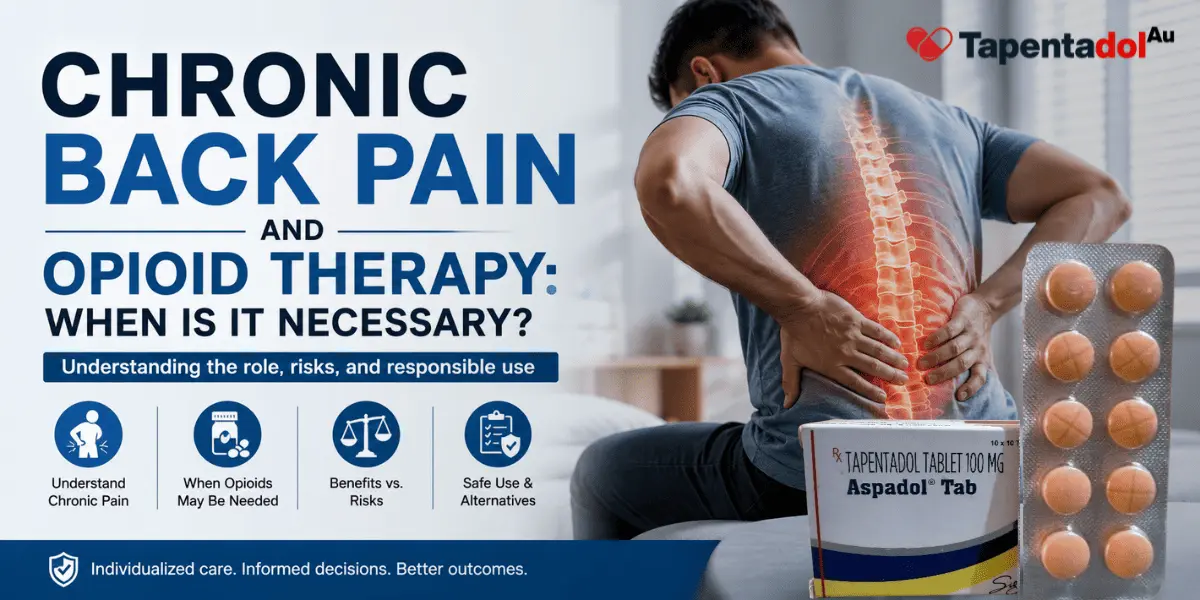
Chronic back pain affects approximately 4 million Australians — making it one of the leading causes of disability and reduced quality of life in the country. For most people, physiotherapy, lifestyle changes, and over-the-counter medications provide adequate relief. But for a subset of patients, the pain persists, intensifies, and begins to interfere with daily functioning.
This is where opioid therapy enters the conversation.
The decision to use opioids for chronic back pain is not taken lightly by medical professionals. It involves careful evaluation, risk assessment, and an understanding of when the benefits outweigh the risks. Tapentadol — available online through regulated pharmacy channels — is one of the opioid analgesics now discussed in this context due to its dual mechanism of action and comparatively lower side-effect profile.
This guide explains what chronic back pain is, when opioid therapy is considered medically appropriate, and how tapentadol fits within current Australian pain management frameworks.
What Is Chronic Back Pain?
Chronic back pain is defined as pain persisting for **12 weeks or longer**,even after an initial injury or underlying cause has been treated. It can affect the lower back (lumbar), mid-back (thoracic), or neck (cervical) region.
Common Causes Include:
- Degenerative disc disease : breakdown of spinal discs over time.
- Herniated or bulging discs : pressure on surrounding nerves.
- Spinal stenosis : narrowing of the spinal canal.
- Spondylolisthesis : vertebral slippage.
- Facet joint arthritis : inflammation in the small joints of the spine.
- Failed back surgery syndrome (FBSS) : persistent pain following surgery.
- Fibromyalgia : widespread musculoskeletal pain with central sensitisation.
Unlike acute back pain, which typically resolves with rest and short-term medication, chronic back pain involves complex neurological changes that make standard treatments insufficient for many patients.
The Treatment Ladder: What Comes Before Opioid
Australian clinical guidelines (Therapeutic Guidelines, NPS MedicineWise) recommend a stepwise approach to chronic back pain management:
Step 1 : Non-Pharmacological Therapies
- Physiotherapy and exercise rehabilitation.
- Cognitive Behavioural Therapy (CBT).
- Mindfulness-based stress reduction.
- Hydrotherapy and weight management.
- TENS (Transcutaneous Electrical Nerve Stimulation).
Step 2 : Mild to Moderate Analgesics
- Paracetamol (limited evidence for chronic use).
- NSAIDs (ibuprofen, naproxen) — short-term use recommended.
- Topical agents (diclofenac gel, lidocaine patches).
Step 3 : Adjuvant Medications
- Low-dose tricyclic antidepressants (amitriptyline).
- SNRIs (duloxetine) — particularly for neuropathic components.
- Gabapentinoids (pregabalin, gabapentin) — for nerve pain.
Step 4 : Opioid Therapy
Opioids are considered only when:
- Steps 1–3 have been tried and failed.
- Pain is significantly impacting quality of life and function.
- A comprehensive pain assessment has been completed.
- Risks of opioid use have been evaluated and discussed.
When Is Opioid Therapy Considered Necessary?
Opioid therapy for chronic back pain is appropriate in specific clinical scenarios. It is not a first-line treatment -but for the right patient,it can be transformative.
Clinically Recognised Indications:
1. Severe, refractory nociceptive or neuropathic pain
When pain scores remain high (7–10/10) despite multimodal treatment,opioids may provide the analgesic coverage that other medications cannot.
2. Failed back surgery syndrome (FBSS)
Patients who continue to experience debilitating pain after spinal surgery often have limited remaining options. Opioid therapy is a recognised management strategy in this population.
3. Cancer-related spinal pain
Malignant involvement of the spine — whether primary or metastatic : frequently requires opioid analgesia as part of palliative care protocols.
4. Significant functional impairment
When pain prevents a patient from performing basic daily activities(walking, sleeping, working), opioid therapy may restore a meaningful level of function that non-opioid treatments have failed to achieve.
5. Neuropathic back pain unresponsive to adjuvants
Nerve root compression or central sensitisation that doesn't respond adequately to pregabalin or duloxetine may benefit from an opioid with noradrenergic activity, such as tapentadol.
What Is Tapentadol and How Does It Work?
Tapentadol is a centrally acting analgesic with a unique dual mechanism:
1. Mu-opioid receptor (MOR) agonism : provides direct pain relief by activating opioid receptors in the brain and spinal cord
2. Norepinephrine reuptake inhibition (NRI) : enhances descending pain inhibition pathways, particularly effective for neuropathic pain
This dual action makes tapentadol distinct from traditional opioids like oxycodone or morphine, which rely solely on opioid receptor activation.
Clinical Advantages of Tapentadol:
| Feature | Tapentadol | Traditional Opioids |
|---|---|---|
| Mechanism | MOR + NRI | MOR only |
| GI side effects | Lower incidence | Higher incidence |
| Neuropathic efficacy | Strong | Moderate |
| Abuse potential | Lower (Schedule 8) | Higher |
| Tolerability | Generally better | Variable |
Formulations:
- Immediate-release (IR): 50mg, 75mg, 100mg — for acute pain episodes.
- Extended-release (ER): 50mg–250mg — for around-the-clock chronic pain management.
Tapentadol ER (brand name Palexia SR in Australia) is specifically approved for **severe chronic pain** requiring continuous opioid treatment.
Tapentadol for Chronic Back Pain: Evidence Summary
Several randomised controlled trials have evaluated tapentadol ER for chronic low back pain
- A 15-week trial published in Pain Physician found tapentadol ER provided significant improvements in pain intensity and physical function compared to placebo in patients with moderate-to-severe chronic low back pain
- Comparative studies against oxycodone CR showed equivalent analgesic efficacy with notably fewer gastrointestinal adverse events(nausea, constipation, vomiting).
- Patients with a neuropathic component to their back pain showed superior outcomes with tapentadol compared to pure opioid agonists, attributed to the NRI mechanism.
The evidence positions tapentadol as a viable option for patients who require opioid-level analgesia but have experienced intolerable side effects with other opioids, or who have a mixed nociceptive-neuropathic pain profile.
Risks and Considerations of Opioid Therapy
No discussion of opioid therapy is complete without addressing risk.Australian prescribers follow strict guidelines for opioid initiation,monitoring, and cessation.
Key Risks Include:
- Dependence and tolerance : requiring dose escalation over time.
- Opioid-induced hyperalgesia : paradoxical increased pain sensitivity.
- Constipation : most common side effect across all opioids.
- Sedation and cognitive effects : particularly in older patients.
- Respiratory depression : risk increases with dose and co-medications.
- Hormonal disruption : long-term use can affect testosterone and cortisol.
Contraindications:
- Concurrent benzodiazepine or CNS depressant use
- Severe respiratory disease (COPD, sleep apnoea)
- History of opioid or substance use disorder
- Pregnancy or breastfeeding
- Monoamine oxidase inhibitor (MAOI) use within 14 days
Safe Prescribing Practices:
- Start at the lowest effective dose
- Regular review (every 4–12 weeks)
- Functional outcome monitoring — not just pain scores
- Opioid Risk Tool (ORT) assessment before initiation
- Urine drug screening where appropriate
- Clear tapering plan from the outset
Australian Regulatory Context
In Australia, tapentadol is classified as a Schedule 8 (S8) controlled substance under the Standard for the Uniform Scheduling of Medicines and Poisons (SUSMP). This means:
- A valid prescription from a registered Australian medical practitioner is required
- Prescribers in most states require S8 authority for chronic non-cancer pain treatment
- Dispensing is recorded in state-based real-time prescription monitoring systems (e.g., SafeScript in Victoria, Electronic Recording and Reporting of Controlled Drugs in NSW)
Patients seeking tapentadol online must obtain it through TGA-registered,Australian-licensed pharmacy channels with a valid prescription.Obtaining controlled substances without a prescription is illegal and carries serious health and legal consequences.
Frequently Asked Questions
Yes. Tapentadol is generally considered more potent than tramadol and is classified at a higher schedule in Australia. It has a more direct opioid receptor action compared to tramadol, which relies partly on metabolic conversion for efficacy.
Duration depends on individual clinical response and ongoing review. Australian guidelines recommend the shortest effective duration. Long-term use (beyond 90 days) requires documented functional benefit and regular specialist review.
Yes. A multimodal approach combining pharmacological treatment(including tapentadol where appropriate) with physiotherapy and psychological support is considered best practice for chronic back pain management.
Tolerance can develop over time. Options include dose adjustment,rotation to another opioid, or reassessment of the overall pain management strategy. Abrupt cessation should be avoided :tapering under medical supervision is required.
Tapentadol is available through licensed online pharmacy platforms in Australia with a valid prescription. It cannot legally be dispensed without one.
Please log in to add a comment.

Dr. James Lawson, a distinguished expert in pain management and pharmaceutical sciences. With over 20 years of medical experience, Dr. Lawson remains deeply committed to advancing safe and effective pain relief solutions. Though no longer in active clinical practice, his passion for healthcare and dedication to patient education continue to thrive. Through his extensive research and medical writing, Dr. Lawson supports our pharmacy’s mission by providing trusted insights on pain management, helping our valued customers make informed health decisions.

.svg)
Delivered in secure, plain packaging on fully tracked delivery from just $20AUD.

Our team of doctors and pharmacists, and our support staff, are all AUS-based.
.svg)
Have a question? Telephone support is always free; Monday - Friday, 9am - 5pm.